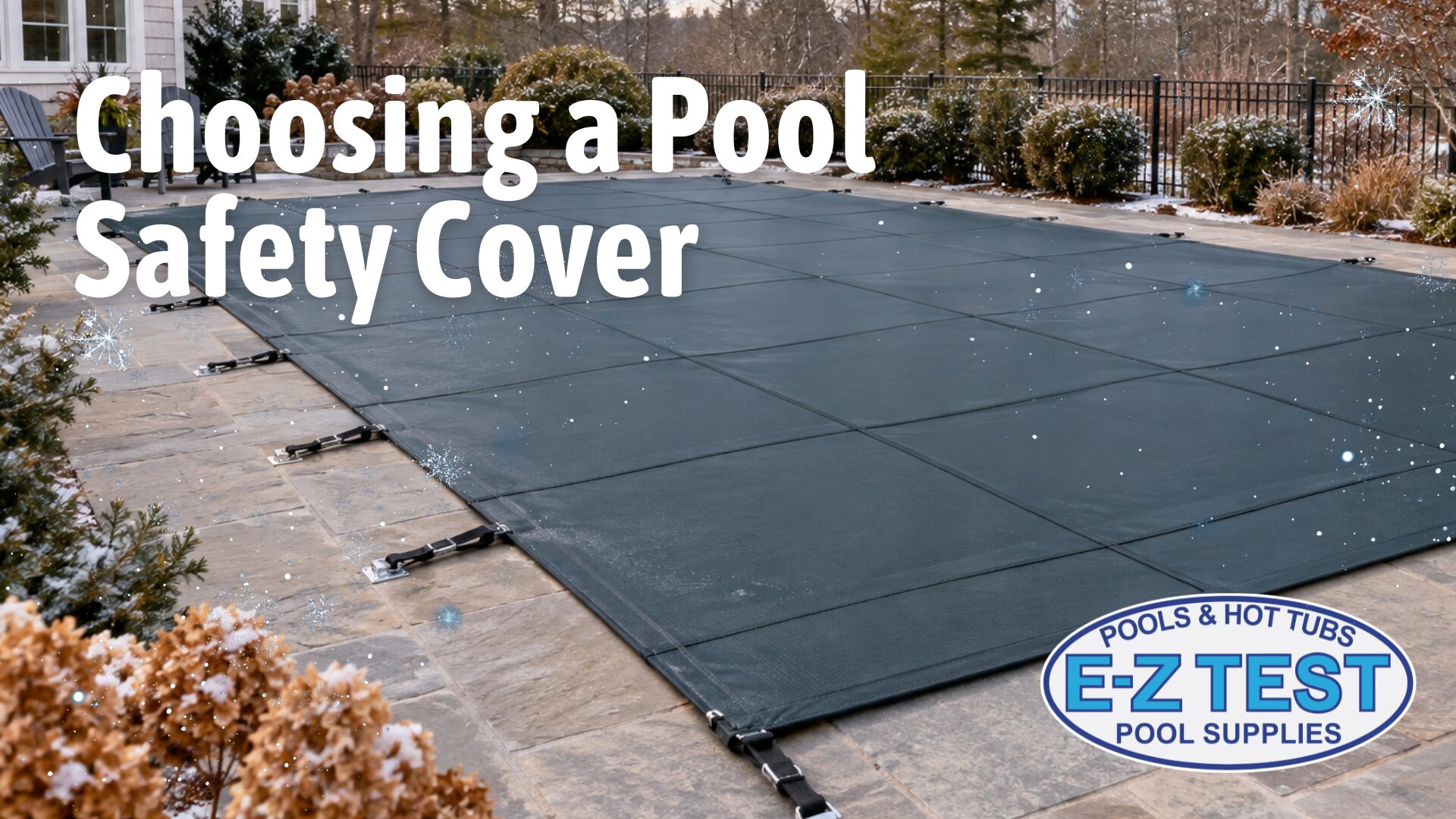
Closing your pool for winter is about more than keeping out leaves. The cover you choose affects how you manage debris, rain, and snow. A pool safety cover for winter, when properly selected and installed, also provides an important layer of protection around the water.
For homeowners in New Hampshire and Massachusetts, the decision often arrives at a busy time of year. Fall leaf drop, changing temperatures, pool-closing schedules, and the prospect of snow can make a worn or poorly fitting cover impossible to ignore. The best time to think through a replacement is before the pool is fully closed and before installation calendars become crowded.
A pool cover is not a substitute for supervision, barriers, secure gates, alarms, or other pool-safety practices. But a true safety cover can be part of a broader safety plan when it meets the applicable standard and is installed and used as intended. ASTM F1346 establishes performance requirements for safety covers for pools, spas, hot tubs, and wading pools.
Start With the Right Question
The first question is not necessarily, “Which brand should I buy?”
A better question is: What does my pool and property need the cover to do over the winter?
For one household, that may mean preventing heavy leaf debris from entering the water. For another, it may mean managing a pool with an irregular shape, built-in steps, a raised spa, or a deck that requires a custom anchoring approach. For families with children or pets, access prevention may be central to the decision.
A good cover decision balances several factors:
Your pool’s shape, dimensions, steps, ladders, water features, and raised walls
Whether the pool is inground or above ground
The amount of leaf and branch debris around the pool
How you prefer to manage rainwater and melting snow
The condition of the surrounding deck or anchoring area
Whether you want professional measuring and installation
Whether the selected cover system meets applicable ASTM safety-cover requirements
A cover that is right for a simple rectangle may not be right for a freeform pool with a raised spa, a diving board, or a custom deck layout. That is why measurements and site details matter as much as material choice.
Winter Cover or Safety Cover?
“Pool cover” is a broad term. A basic winter cover may help keep debris out of a closed pool, but it is not automatically a safety cover.
A safety cover is a complete system—not just a piece of fabric stretched over the water. Depending on the product and pool design, the system can include the cover material, reinforced webbing, straps, springs, anchors, hardware, fit, and tension. All of those pieces must work together.
When safety is part of the purchase decision, ask whether the exact cover system, not simply a similar-looking material, meets ASTM F1346 requirements. Also ask how the system will be measured, installed, tensioned, and maintained. A safety cover should be used only as directed by its manufacturer, and it should never be treated as permission for children, adults, or pets to walk or play on the cover.
For an existing pool, it is also worth noting whether the current hardware is still sound. In some cases, a replacement cover may be designed to work with existing anchors and hardware; in others, the pool and deck may need a more complete evaluation. E‑Z Test offers measuring, ordering, installation, and replacement-cover support for Loop-Loc safety-cover systems.
Mesh vs. Solid Safety Covers
Many pool owners eventually narrow the choice to mesh or solid material. Neither is automatically “better” in every situation. The right fit depends on how you manage the pool, what falls into it during autumn, and how much cover maintenance you prefer to take on.
Consideration
Mesh safety cover
Solid safety cover
Rain and snowmelt
Water passes through the fabric
Water stays on the cover and typically needs to be removed with a cover pump
Sunlight
Some light can pass through, depending on the material
Blocks sunlight from reaching the water
Debris
Keeps out most leaves and larger debris
Keeps out debris
Maintenance focus
Inspect tension, straps, anchors, and seasonal condition
Inspect tension and hardware, plus manage water that collects on top
Common deciding factor
Homeowners who prefer drainage through the cover
Homeowners who prefer a light-blocking barrier and are prepared to manage surface water
Loop-Loc offers mesh safety-cover options designed to allow rain and melting snow to drain through while blocking virtually all sunlight, according to the manufacturer. Exact performance, warranty terms, available materials, and fit should be confirmed for the specific model being quoted.
The practical question is not simply whether water can pass through the cover. It is whether that approach fits your property and maintenance habits. A heavily wooded backyard may create a different set of concerns than an open yard. Likewise, a homeowner who wants to avoid using a cover pump may weigh the options differently from someone who prefers solid material and is comfortable monitoring accumulated water.
Pool Shape Changes Everything
A pool that looks straightforward from the house can become more complex once measurements begin.
Straight rectangular pools are often the simplest to cover. But steps, ladders, handrails, diving boards, fountains, attached spas, raised walls, landscaping edges, and unusual deck configurations can all affect the way a cover fits and secures.
This is especially important when the pool has a raised feature. A gap around a spa wall, waterfall, or other obstruction may create a point that needs special attention in the cover design. Loop-Loc describes its GapGuard and Cable-Loc features as intrusion barriers intended to address gaps around certain raised obstructions, but the proper solution depends on the pool’s actual layout.
For that reason, photos and rough measurements are useful before a store conversation, but they are not a replacement for a professional site measurement when a custom cover is needed.
What to Check Before Replacing a Cover
If your existing cover has been in service for several seasons, fall is a useful time to inspect it honestly. Look for visible wear in the fabric, webbing, straps, springs, stitching, anchors, or surrounding deck area. A cover may still appear serviceable from a distance while having components that no longer tension correctly or hardware that needs attention.
Consider replacement or professional evaluation if you notice:
Tears, fraying, loose stitching, or damaged webbing
Sagging that does not improve with correct tensioning
Bent, corroded, loose, or missing hardware
A cover that no longer fits tightly around the pool perimeter
Changes to the pool area, such as a new deck, raised spa, landscaping, or equipment
A cover whose age, warranty, or safety documentation is unclear
Do not wait until snow is in the forecast to discover that the cover no longer fits as it should.
Planning for a Better Fit
A useful cover consultation starts with the details that are easy to overlook. Before speaking with a cover specialist, gather:
A few clear photos of the full pool area and the deck perimeter
Approximate pool dimensions and shape
Notes about steps, ladders, handrails, diving boards, water features, or raised walls
The deck material around the pool
Photos of the existing anchors and cover, if there is one
A description of the main problem you want to solve—debris, water management, fit, wear, safety planning, or all of the above
This preparation helps turn the conversation from “What covers do you sell?” into “What type of system makes sense for this particular pool?”
A Local, Practical Next Step
A safety cover is a long-term piece of pool equipment, not a last-minute seasonal accessory. The right system should fit the pool, match the property’s needs, and be installed and maintained according to the manufacturer’s requirements.
E‑Z Test Pool Supplies offers Loop-Loc safety-cover support, including measuring, ordering, new-cover installation, and replacement-cover options. Their stores serve pool owners from Derry and Plaistow, New Hampshire, to North Reading and nearby Massachusetts communities.
Before your pool is closed for the season, bring photos and rough dimensions to your nearest E‑Z Test location. A store conversation can help you determine whether your current cover needs attention and what information is needed for a properly fitted replacement.
How Long After Shocking a Pool Can You Swim? | E-Z Test Pool Supplies Before jumping into your pool, make sure the water is safe—not just clear. Crystal-clear water does not always mean it is properly sanitized. The best way
Balancing Your Pool After Rain: How to Get Your Water Perfect Again Heavy rain can quickly throw your pool water out of balance. Whether you’re dealing with cloudy water, diluted chlorine, or debris after a New England storm, restoring your
Water Tech Volt FX-8Li Pool Vacuum Powerful Cordless Pool Cleaning Made Easy Keeping your pool clean doesn’t have to be a time-consuming chore. The Water Tech Volt FX-8Li delivers powerful cordless performance, making it easy to remove leaves, dirt, sand,